Introduction
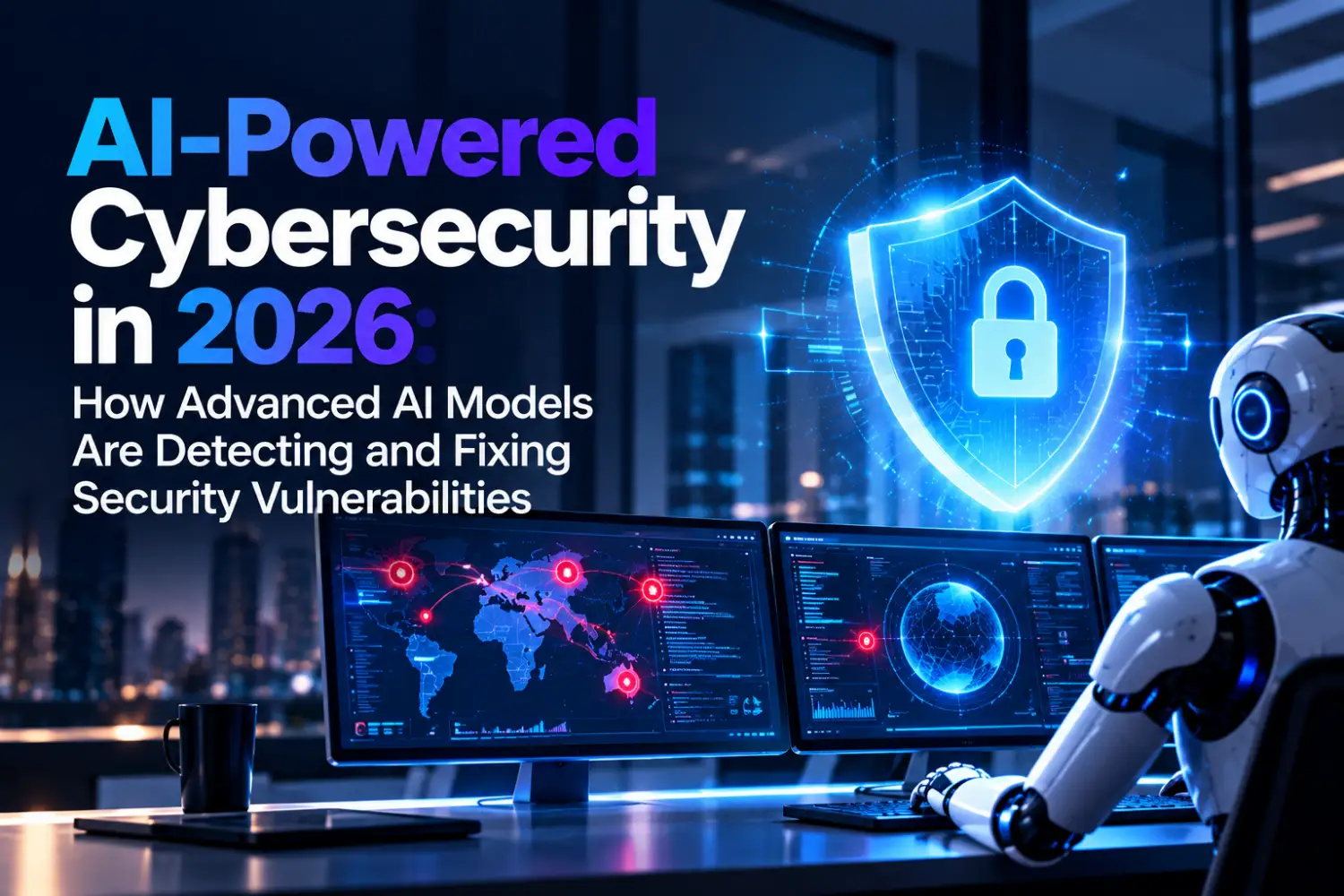
Cybersecurity is entering a new era in 2026. As businesses become increasingly dependent on cloud platforms, digital applications, APIs, and interconnected systems, cyber threats are becoming more sophisticated and difficult to manage. Traditional security tools that rely heavily on predefined rules and manual investigation are struggling to keep pace with rapidly evolving attacks.
Artificial Intelligence (AI) is changing this landscape.
Advanced AI models, machine learning algorithms, and autonomous AI agents are helping organizations identify security vulnerabilities, analyze suspicious activities, predict potential attacks, and accelerate security fixes. Instead of simply detecting threats after they occur, modern AI-powered cybersecurity systems can help businesses identify weaknesses before attackers exploit them.
In 2026, AI is no longer just an additional cybersecurity feature. It is becoming an important part of modern security strategies.
In this guide, we explore how AI-powered cybersecurity works, how advanced AI models detect and fix vulnerabilities, the technologies transforming digital security, and how businesses can prepare for the next generation of cyber threats.
What Is AI-Powered Cybersecurity?
AI-powered cybersecurity refers to the use of artificial intelligence, machine learning, deep learning, and intelligent automation to protect digital systems, applications, networks, and sensitive information from cyber threats.
Traditional cybersecurity systems generally depend on predefined rules, known attack signatures, and manually configured security policies. AI-powered systems go further by analyzing large amounts of data, recognizing unusual patterns, identifying suspicious behavior, and continuously improving threat detection.
For example, an AI-powered security system can:
- Identify unusual login attempts and suspicious access patterns.
- Detect vulnerabilities in application source code.
- Analyze network traffic to identify potential attacks.
- Recognize malware and suspicious files.
- Identify exposed credentials and misconfigured cloud resources.
- Recommend security improvements and code-level fixes.
- Automate selected incident response activities.
By combining intelligent analysis with automated security workflows, businesses can improve their ability to identify and respond to emerging threats.
Why AI-Powered Cybersecurity Is Becoming Essential in 2026
The cybersecurity environment is changing rapidly. Attackers are using automation and AI-assisted techniques to research vulnerabilities, analyze software, generate malicious code, and conduct attacks at greater speed.
At the same time, organizations are managing increasingly complex technology environments involving cloud infrastructure, remote employees, third-party integrations, mobile applications, and AI-powered software.
Several factors are making AI-driven cybersecurity increasingly important.
1. Increasing Complexity of Cyber Threats
Modern cyberattacks are not always based on simple malware or suspicious emails. Attackers may combine stolen credentials, application vulnerabilities, social engineering, and compromised third-party services to access business systems.
AI helps security teams analyze these interconnected signals and identify suspicious activity that might otherwise go unnoticed.
2. Faster Vulnerability Discovery
AI models can analyze large codebases, dependencies, and application configurations to identify potential weaknesses. This can help developers discover security issues earlier in the software development lifecycle.
3. Growing Cloud and API Security Risks
Businesses increasingly depend on cloud applications, APIs, and external integrations. Misconfigured permissions, exposed endpoints, and insecure authentication can create opportunities for attackers.
AI-powered security tools can continuously analyze these environments and highlight unusual access patterns or configuration risks.
4. Limited Cybersecurity Resources
Many organizations do not have large security teams capable of manually investigating every alert. AI-assisted monitoring and automated analysis can reduce repetitive work and help security professionals focus on critical threats.
How Advanced AI Models Detect Security Vulnerabilities
One of the most important developments in 2026 is the ability of advanced AI models to analyze software and identify potential security vulnerabilities.
Unlike conventional tools that primarily search for known vulnerability patterns, advanced AI systems can reason about application logic, understand code relationships, and investigate how different components interact.
Here are the major ways AI models are transforming vulnerability detection.
1. AI-Powered Source Code Analysis
AI models can examine application source code to identify insecure coding practices, authentication weaknesses, improper input validation, and potentially dangerous data handling.
For example, an AI model analyzing a web application may identify:
- SQL injection risks.
- Cross-site scripting (XSS) vulnerabilities.
- Insecure authentication mechanisms.
- Improper access control.
- Sensitive information exposure.
- Unsafe API implementations.
Advanced code-analysis systems can also explain why a particular coding pattern is risky and suggest safer alternatives.
This helps development teams identify security problems before deploying applications into production.
2. Intelligent Zero-Day Vulnerability Detection
A zero-day vulnerability is a software weakness that is unknown to the vendor or has no available security patch at the time it is discovered or exploited.
Detecting these vulnerabilities is challenging because traditional signature-based security systems may not recognize them.
AI-powered security research systems can analyze application behavior, code paths, memory interactions, and unusual execution patterns to identify previously unknown weaknesses.
However, AI detection does not guarantee that every zero-day vulnerability will be discovered. Human security researchers, controlled testing, and independent validation remain essential.
3. AI-Based Behavioral Threat Detection
Traditional security solutions often focus on identifying known malicious activity. AI-based behavioral detection focuses on understanding what normal activity looks like and identifying deviations.
For example, an employee account that normally accesses business records during office hours suddenly downloading thousands of confidential files at midnight could trigger an investigation.
AI systems can analyze:
- Login frequency and location patterns.
- Unusual file access.
- Unexpected privilege changes.
- Suspicious network communication.
- Abnormal application behavior.
This approach helps organizations identify potentially compromised accounts and insider threats.
4. Intelligent API and Cloud Security Analysis
APIs connect websites, mobile applications, databases, payment systems, and third-party services. A poorly secured API can expose sensitive business information.
AI models can assist with API security testing by analyzing endpoint behavior, authentication requirements, access permissions, and unusual request patterns.
Similarly, AI-powered cloud security tools can identify misconfigured storage, excessive permissions, exposed credentials, and suspicious infrastructure changes.
5. Automated Vulnerability Prioritization
Not every security vulnerability represents the same level of risk.
A low-impact configuration issue may be less urgent than a vulnerability that allows unauthorized access to customer information.
AI-powered vulnerability management can combine information such as:
- Vulnerability severity.
- Asset importance.
- Exploit availability.
- Exposure to the public internet.
- Observed attack activity.
- Potential business impact.
This helps security teams prioritize vulnerabilities based on real-world risk instead of treating every security alert equally.
How AI Models Are Fixing Security Vulnerabilities
Finding vulnerabilities is only one part of cybersecurity. Businesses also need to resolve identified issues quickly and safely.
In 2026, advanced AI-powered systems are increasingly supporting the remediation process.
1. AI-Generated Security Patches
When a vulnerability is discovered in application code, AI models can analyze the affected function and recommend a safer implementation.
For example, if an application contains an insecure SQL query, an AI coding assistant may suggest parameterized queries to reduce SQL injection risks.
Developers can review the proposed changes, test them, and integrate approved fixes into the application.
2. Automated Security Testing
After a security fix is implemented, AI-assisted testing can help verify whether the vulnerability has been resolved.
This may involve:
- Re-running security scans.
- Generating test cases.
- Checking application behavior.
- Identifying regression issues.
- Validating access permissions.
Automated testing reduces repetitive work and helps developers identify problems before releasing software updates.
3. Intelligent Incident Response
AI-powered security platforms can help investigate suspicious activities and recommend appropriate responses.
Depending on the configured permissions, these systems may:
- Flag suspicious accounts.
- Recommend blocking malicious IP addresses.
- Isolate affected endpoints.
- Trigger predefined security workflows.
- Notify security administrators.
- Generate incident summaries.
High-impact actions should remain subject to appropriate authorization and human oversight.
4. AI-Assisted Security Configuration
Incorrect security configurations are a common source of business risk.
AI tools can review cloud permissions, application settings, authentication policies, and infrastructure configurations to recommend improvements.
For example, an AI system may identify an unnecessarily public storage resource or an account with excessive administrative permissions.
It can then recommend a more secure configuration for review.
Top AI Technologies Transforming Cybersecurity in 2026
Several AI technologies are playing important roles in modern cybersecurity.
Large Language Models (LLMs)
Large Language Models can understand source code, analyze security documentation, summarize incidents, and explain vulnerabilities in natural language.
They help developers and security teams investigate technical issues more efficiently.
Machine Learning (ML)
Machine learning models identify patterns in network traffic, login activity, system logs, and endpoint behavior. They can help detect suspicious activities that differ from established baselines.
Deep Learning
Deep learning techniques can analyze complex datasets and identify relationships that may be difficult to detect through conventional rule-based approaches.
They are useful in areas such as malware classification, anomaly detection, and threat intelligence analysis.
Agentic AI
Agentic AI systems can perform multi-step tasks by planning actions, using approved tools, analyzing results, and deciding what to investigate next.
In cybersecurity, specialized agents can support vulnerability research, security testing, incident investigation, and remediation workflows.
However, autonomous agents must operate with restricted permissions, clear boundaries, and audit logging.
Retrieval-Augmented Generation (RAG)
RAG combines language models with trusted external knowledge sources.
In cybersecurity, RAG can help AI systems retrieve relevant internal security policies, vulnerability documentation, technical guidelines, and historical incident reports before generating recommendations.
This improves contextual relevance and helps teams verify recommendations against approved information.
Real-World Developments in AI Cybersecurity in 2026
AI-powered cybersecurity is moving beyond experimental research into practical security operations.
Several developments demonstrate this shift.
1. Microsoft Advances Multi-Agent Vulnerability Detection
Microsoft announced its multi-model agentic security system, MDASH, in May 2026. The system coordinates more than 100 specialized AI agents to discover, investigate, and validate software vulnerabilities.
Microsoft reported that its research identified 16 previously unknown vulnerabilities in Windows components, including four critical remote code execution vulnerabilities.
This demonstrates how coordinated AI agents can support complex security research.
2. Google Introduces AI Threat Defense
Google announced Google AI Threat Defense in May 2026 to help organizations identify security weaknesses, prioritize real-world risks, and accelerate remediation.
The platform reflects a broader shift toward continuous and context-aware cybersecurity rather than relying exclusively on periodic vulnerability scans.
3. AI Models Help Discover and Remediate Vulnerabilities
In September 2026, Google Threat Intelligence Group published research showing that vulnerability disclosures increased substantially during 2026.
Its analysis reported that monthly vulnerability disclosures rose from 5,045 in January to 10,740 in August 2026.
The research also highlighted the growing importance of threat intelligence and risk-based prioritization as AI-assisted vulnerability discovery becomes more common.
These developments show that AI is strengthening defensive capabilities while also increasing the speed and scale of potential cyber threats.
AI-Powered Cybersecurity vs Traditional Cybersecurity
Both traditional and AI-powered cybersecurity have important roles in protecting business systems. The difference lies in how they analyze threats and support security operations.
| Area | Traditional Cybersecurity | AI-Powered Cybersecurity |
|---|---|---|
| Threat detection | Rules and signatures | Pattern and behavior analysis |
| Code analysis | Rule-based scanning | Context-aware code analysis |
| Vulnerability management | Manual prioritization | Risk-based prioritization |
| Incident investigation | Manual workflows | AI-assisted investigation |
| Response | Predefined actions | Context-aware automation |
| Monitoring | Scheduled or continuous | Continuous intelligent analysis |
AI does not make traditional security tools unnecessary. The strongest cybersecurity strategies combine conventional security controls with intelligent AI-based capabilities.
How Businesses Can Implement AI-Powered Cybersecurity
Organizations do not need to replace their entire security infrastructure to benefit from AI.
A practical implementation strategy can begin with a few important steps.
Step 1: Assess Your Existing Security Infrastructure
Evaluate existing applications, cloud services, databases, APIs, authentication systems, and network configurations.
Identify areas where security monitoring and vulnerability management need improvement.
Step 2: Introduce AI-Assisted Vulnerability Scanning
Use appropriate AI-assisted security tools to analyze source code, application dependencies, APIs, and cloud configurations.
Start with controlled environments and authorized testing.
Step 3: Strengthen Identity and Access Management
Implement multi-factor authentication, role-based access control, least-privilege permissions, and regular access reviews.
AI can help identify unusual account behavior, but strong identity controls remain fundamental.
Step 4: Integrate Security Into the Development Lifecycle
Introduce security checks into development and deployment workflows.
AI-assisted code reviews, dependency analysis, automated testing, and continuous integration pipelines can help detect problems before software reaches production.
Step 5: Establish Human Approval and Monitoring
AI-generated security recommendations should be reviewed and validated before implementation.
Maintain audit logs, restrict agent permissions, and establish clear escalation procedures for high-risk incidents.
Step 6: Continuously Improve Security Practices
Cyber threats evolve constantly. Organizations should regularly review security policies, update software, test recovery procedures, and assess the effectiveness of their security systems.
Challenges and Risks of AI-Powered Cybersecurity
Although AI provides significant cybersecurity opportunities, it also introduces new challenges.
False Positives and False Negatives
AI systems may incorrectly flag legitimate activities or fail to identify actual threats. Security teams should validate important findings before taking action.
Data Privacy Concerns
Security analysis may involve sensitive source code, customer information, business records, and internal system data.
Organizations must carefully evaluate where their data is processed, how it is stored, and who can access it.
AI Model Manipulation
Attackers may use prompt injection, poisoned data, or malicious inputs to influence AI-powered security systems.
AI agents must therefore operate within controlled environments with strict access restrictions.
Overdependence on Automation
Relying entirely on automated security decisions can create additional risks. Critical security actions should involve human authorization, testing, and accountability.
Integration Complexity
Connecting AI security solutions with existing applications, cloud platforms, development tools, and monitoring systems may require specialized engineering expertise.
The Future of AI-Powered Cybersecurity Beyond 2026
The next generation of cybersecurity will likely focus on intelligent, adaptive, and increasingly automated protection.
Some important developments to watch include:
- Autonomous vulnerability research and validation.
- Multi-agent security operations.
- AI-powered secure software development.
- Predictive threat intelligence.
- Continuous cloud and API security monitoring.
- Automated security testing and remediation.
- Improved protection for enterprise AI applications.
As AI becomes more deeply integrated into business software, organizations will also need to secure their AI models, training data, agents, and connected tools.
The future will not simply be about using AI to detect cyberattacks. It will be about building software and infrastructure that can identify weaknesses, respond intelligently, and continuously improve security.
How True Value Infosoft Can Help Businesses Build Secure AI-Powered Solutions
As businesses adopt AI-powered applications and digital platforms, security must be considered from the beginning of the development process.
True Value Infosoft helps businesses build intelligent digital solutions through expertise in AI development, software engineering, application integration, and business automation.
Our technology capabilities can support organizations looking to develop more secure and intelligent business systems.
Our relevant capabilities include:
- AI Development Services – Build intelligent business solutions using modern AI technologies.
- AI Agent Development – Develop autonomous agents with controlled workflows and business integrations.
- AI Integration – Integrate AI capabilities into existing business applications and digital platforms.
- Custom Software Development – Build business applications with security-conscious architecture and scalable infrastructure.
- Web Application Development – Develop modern web applications with appropriate authentication, authorization, and secure coding practices.
- API Integration – Connect business systems through structured and secure API integrations.
- Cloud-Based Solutions – Build scalable digital platforms with appropriate infrastructure and access controls.
Whether you are planning an AI-powered business application, modernizing an existing platform, or integrating intelligent automation into your operations, choosing the right development partner is an important step.
True Value Infosoft focuses on building practical, scalable, and business-oriented technology solutions that help organizations move forward with confidence.
Conclusion: AI Is Becoming a Critical Part of Modern Cybersecurity
Cybersecurity in 2026 is evolving faster than ever. Advanced AI models are helping organizations discover vulnerabilities, understand suspicious behavior, prioritize critical risks, and accelerate security remediation.
However, AI alone cannot guarantee complete protection. Strong security architecture, secure software development, continuous monitoring, regular testing, and human oversight remain essential.
Businesses that combine traditional security practices with responsible AI adoption will be better positioned to manage emerging digital threats.
The opportunity is clear: use AI not just to respond to cyberattacks, but to build stronger, more resilient digital systems.
Ready to build smarter and more secure digital solutions?
Connect with True Value Infosoft to explore AI development, custom software engineering, intelligent automation, and secure digital transformation solutions for your business.