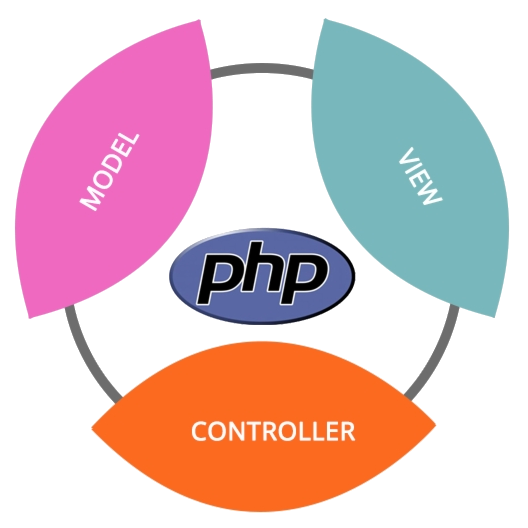
Model. View. Controller. Clean, Scalable Architecture.
PHP is one of the most widely used server-side scripting languages for web development. As web applications grow in complexity, maintaining code becomes a challenge — this is where the Model-View-Controller (MVC) architectural pattern comes into play.
PHP MVC is a framework-based approach that separates concerns within an application, making it more organized, scalable, and maintainable. At True Value Infosoft, we specialize in delivering high-performance web applications using the PHP MVC pattern across industry-leading frameworks like Laravel, Symfony, and CodeIgniter.
Let's Get StartedFill in the details below — our team will reach out shortly.
PHP MVC is a software design pattern that divides an application into three interconnected components: Model — represents business logic and data handling, interacting with the database; View — manages the presentation layer, displaying information to the user; and Controller — handles user input, processes requests, and bridges the Model and View.
By separating these concerns, PHP MVC ensures a clean, modular structure that makes large-scale applications far easier to manage, test, and extend over time.
Clean MVC Architecture
The MVC pattern brings structure, clarity, and power to PHP development — making it the standard approach for professional web applications.
Code Organization
MVC enforces a structured coding approach, making code easier to read, navigate, and maintain across large teams.
Reusability
Components in the Model, View, and Controller can be reused across multiple parts of the application, reducing redundancy.
Scalability
MVC architecture allows adding new features as projects grow without disrupting existing, working functionality.
Built-In Security
MVC frameworks include input validation, SQL injection prevention, CSRF protection, and secure session management.
Faster Development
Ready-to-use components and scaffolding in MVC frameworks dramatically reduce development time and effort.
Team Collaboration
Developers can work independently on the Model, View, or Controller simultaneously without code conflicts.
PHP MVC delivers measurable business value by making development teams more efficient and applications more reliable.
Improved Development Speed
Pre-built components, helpers, and boilerplate code in MVC frameworks accelerate project timelines significantly.
Better Project Organization
Structured separation of concerns keeps large codebases manageable and easy to navigate for any developer.
Easy Debugging & Testing
Isolated components make unit testing and debugging straightforward — issues are caught faster and fixed cleanly.
Efficient Code Reuse
Reusable models and views reduce duplication, speeding up future development and lowering maintenance costs.
Enhanced Team Collaboration
Front-end and back-end developers can work in parallel on Views and Models without blocking each other.
We work across all major PHP MVC frameworks, selecting the right tool based on your project's scale, complexity, and goals.
Laravel
The most widely used PHP MVC framework — elegant syntax, Eloquent ORM, queues, and a vast ecosystem for rapid development.
CodeIgniter
A lightweight, fast MVC framework known for its small footprint and minimal configuration — ideal for quick, lean projects.
Symfony
A high-performance, enterprise-grade framework with reusable components that power Drupal, Magento, and many large platforms.
Yii
A fast and secure MVC framework with built-in caching, RBAC, and scaffolding — great for high-performance web applications.
CakePHP
Known for its convention-over-configuration approach and rapid prototyping capabilities for straightforward web applications.
Phalcon
A blazing-fast PHP framework implemented as a C extension — delivering the lowest overhead and highest performance available.
Follow Naming Conventions
Use consistent PSR-standard naming for files, classes, and methods to keep the codebase predictable and maintainable.
Keep Business Logic in the Model
Never put business logic in Controllers or Views — keep the Model as the single source of truth for data and logic.
Use Templating Engines
Use Twig or Blade for View management — separating PHP logic from HTML for cleaner, more secure templates.
Implement Error Handling & Logging
Set up centralized error handling, structured logging (Monolog), and alerts so issues are caught and resolved quickly.
Secure Authentication & Authorization
Implement role-based access control (RBAC), OAuth, and multi-factor authentication to protect application routes and data.
Optimize Database Queries
Use eager loading, indexes, query caching, and ORM profiling tools to keep database performance sharp under load.
PHP MVC continues to evolve as modern web development demands more. With PHP 8.x JIT compilation, frameworks are becoming faster and more feature-rich than ever. Emerging trends include:
Modern PHP Architecture
True Value Infosoft is a trusted name in PHP MVC development, delivering structured, high-performance web applications built to scale.
Expertise in PHP MVC Frameworks
Our experienced PHP developers are proficient in all major MVC frameworks, ensuring structured, maintainable, and high-performance applications.
Customized Solutions
We build tailored PHP MVC applications that align with your brand identity, business goals, and specific technical requirements.
Scalability & Performance
We architect applications that handle high traffic and scale seamlessly as your business grows, without performance degradation.
Security-First Approach
Our PHP MVC applications follow best security practices — data encryption, secure authentication, and protection against SQL injection and CSRF.
Cost-Effective Development
We deliver affordable, high-quality PHP MVC solutions ensuring maximum return on investment without compromising on code quality.
Timely Delivery & Support
Our agile development approach ensures on-time delivery with post-launch support, updates, and maintenance to keep applications running smoothly.
PHP MVC (Model-View-Controller) is a design pattern that separates an application into three interconnected components: Model (data logic), View (UI), and Controller (request handling). This structure improves code organization, maintainability, and scalability.
MVC separates business logic from presentation for cleaner code, enhances scalability and maintenance, and enables collaborative development where developers can work on different components independently.
Popular PHP MVC frameworks include Laravel, CodeIgniter, Symfony, Yii, CakePHP, and Phalcon — each suited to different project scales and requirements.
The Controller receives user input, processes it using the Model (which handles data and business logic), and then passes the result to the View to render the appropriate response to the user.
True Value Infosoft specializes in PHP MVC development — offering custom web applications, scalable architectures, REST APIs, and optimized performance solutions tailored to your specific business needs.
Stop worrying about technology problems. Focus on your business.
Let us provide the expert IT support you deserve.