Introduction
Finding potential customers is no longer the biggest challenge for businesses. The real challenge is identifying the right prospects, understanding their needs, and converting them into paying customers.
In 2026, traditional lead generation methods such as manual prospect research, cold calling, spreadsheet management, and generic email campaigns are becoming increasingly difficult to scale efficiently.
Sales teams spend valuable time searching for contact information, researching companies, preparing outreach messages, and following up with prospects. Despite these efforts, many businesses still struggle with poor-quality leads, low engagement, and inconsistent sales pipelines.
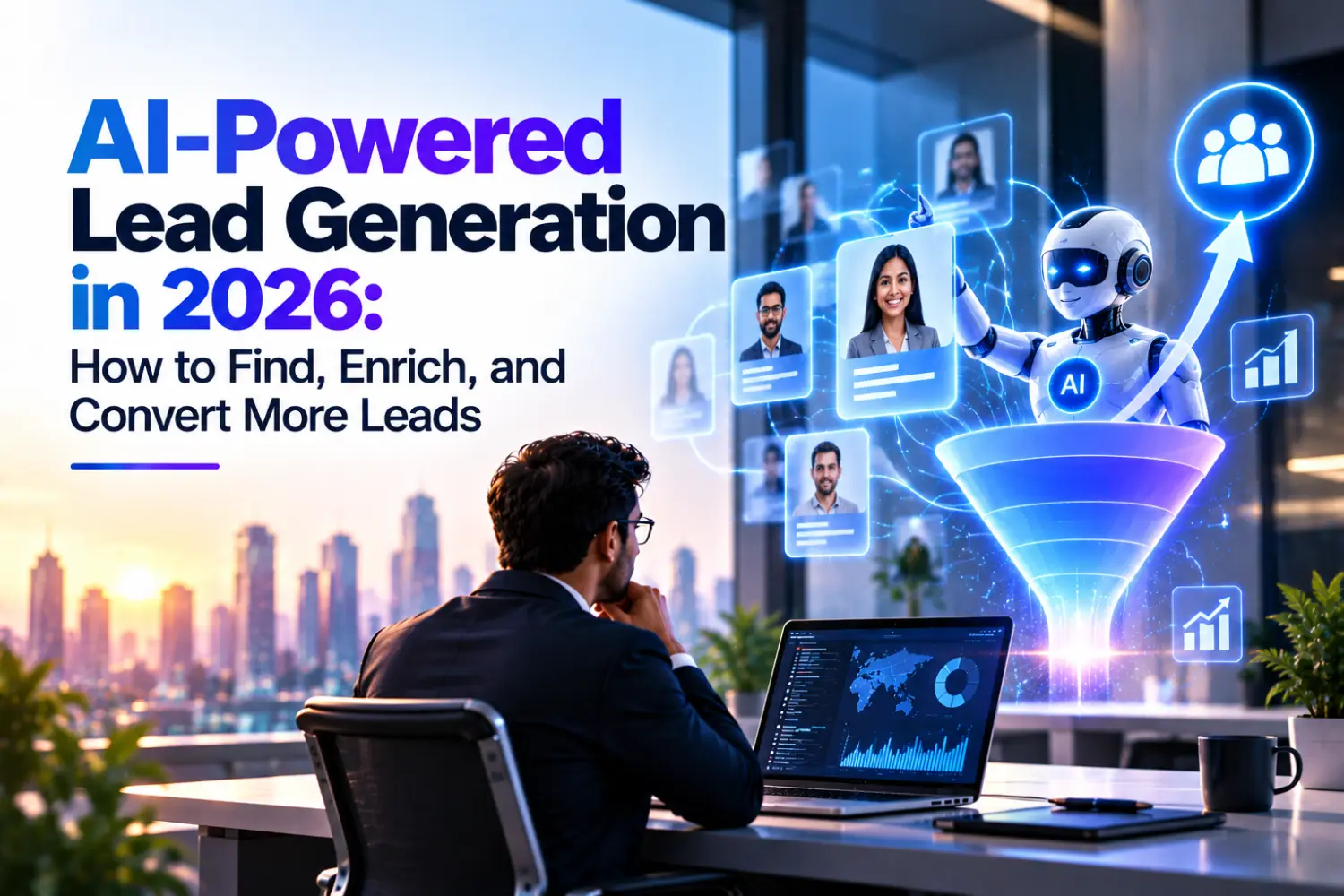
This is where AI-powered lead generation is changing the way businesses approach customer acquisition.
Artificial intelligence helps companies discover potential customers, enrich prospect information, prioritize qualified leads, and personalize sales communication. By combining AI with sales automation software, businesses can reduce repetitive tasks and create more efficient lead generation workflows.
Solutions such as Salezo by True Value Infosoft are designed to bring AI-assisted prospect discovery, lead enrichment, and multi-channel outreach into a more connected sales process.
In this guide, we will explore how AI-powered lead generation works, its benefits, practical strategies, and how businesses can use modern tools to find, enrich, and convert more leads in 2026.
What Is AI-Powered Lead Generation?
AI-powered lead generation is the process of using artificial intelligence, machine learning, and automation technologies to identify, collect, evaluate, and engage potential customers.
Unlike traditional lead generation, which often depends heavily on manual research and repetitive communication, AI-assisted systems can analyze available information, organize prospect data, and support more targeted outreach.
For example, a traditional sales representative might spend hours searching for companies, collecting contact information, and drafting individual emails.
With AI-powered lead generation tools, parts of this process can be streamlined through automated company discovery, data enrichment, prospect segmentation, and AI-assisted message creation.
Key Components of AI-Powered Lead Generation
- AI Prospect Discovery: Identify potential customers based on relevant business criteria.
- Lead Data Enrichment: Improve lead records with available company and contact information.
- AI Lead Qualification: Evaluate prospects against an ideal customer profile and other defined criteria.
- Personalized Outreach: Create relevant sales communication based on prospect context.
- Automated Follow-Ups: Schedule or trigger communication through supported sales workflows.
- Lead Analytics: Track engagement, pipeline movement, and conversion performance.
The goal is not simply to generate more contacts. It is to build a more reliable pipeline of relevant sales opportunities.
Why AI-Powered Lead Generation Matters in 2026
Modern buyers have more information, more choices, and higher expectations from businesses.
Generic sales pitches and poorly targeted outreach often struggle to generate meaningful responses. Businesses need a smarter approach that prioritizes relevance, timing, and customer experience.
1. Reduce Time Spent on Manual Prospecting
Researching companies, organizing contact details, and preparing prospect lists can take hours.
AI-assisted research and automation can reduce repetitive work, giving sales teams more time to focus on relationship building and closing opportunities.
2. Improve Lead Quality
Not every prospect is a potential customer.
AI-supported segmentation and qualification can help businesses focus on leads that match their ideal customer profile.
3. Enable More Relevant Communication
AI can help sales teams draft messages based on a prospect's industry, company profile, or business requirements.
This creates opportunities for more relevant conversations compared with sending identical messages to every contact.
4. Support Faster Lead Follow-Ups
When businesses receive inquiries from websites, advertising campaigns, or messaging channels, delays can result in missed opportunities.
Automated workflows can help teams route new leads, notify the right sales representative, and initiate approved follow-up sequences.
5. Make Lead Generation More Scalable
As a business grows, manually managing hundreds or thousands of prospects becomes increasingly difficult.
AI automation solutions can support larger lead volumes while maintaining structured workflows and appropriate human oversight.
How AI-Powered Lead Generation Works: From Discovery to Conversion
An effective lead generation process consists of several connected stages.
Step 1: Find the Right Prospects Using AI
Successful lead generation begins with identifying businesses or individuals who are likely to benefit from your product or service.
Traditional prospecting often involves searching websites, professional networks, business directories, and online databases.
AI-assisted prospect discovery can make this research process more efficient by helping businesses identify relevant companies using available data.
How AI Supports Prospect Discovery
Businesses can define criteria such as:
- Target industry or business sector.
- Geographic location.
- Company size or business type.
- Target customer profile.
- Relevant products or services.
- Business characteristics that indicate a potential fit.
For example, a software development company targeting healthcare businesses can focus its prospect research on hospitals, clinics, and healthcare technology providers rather than contacting unrelated organizations.
This is where company discovery capabilities in platforms such as Salezo can support a more focused B2B lead generation strategy.
The result is a prospect list built around business relevance instead of simply maximizing contact volume.
Step 2: Enrich Lead Data for Better Sales Decisions
Finding a potential customer is only the beginning.
A prospect record containing just a company name or email address may not provide enough information for meaningful outreach.
Lead enrichment helps businesses improve the completeness and usefulness of their prospect data.
What Is AI Lead Enrichment?
AI lead enrichment involves using available data sources and AI-assisted processing to improve lead records with relevant business information.
Depending on the source and available permissions, this information may include:
- Company name and website.
- Industry or business category.
- Business location.
- Company description.
- Relevant professional roles.
- Available contact details.
- Other information useful for prospect segmentation.
Why Lead Enrichment Matters
Consider two different outreach approaches.
Without lead enrichment:
"Hello, we provide software services. Are you interested?"
With enriched prospect context:
"Hello, we noticed your company operates in the hospitality sector. Our team develops guest engagement and business automation solutions that may be relevant to your operations."
The second message is more specific and gives the recipient a clearer reason to engage.
However, personalization should always rely on accurate, appropriately sourced information rather than unsupported assumptions.
AI-assisted lead enrichment capabilities, such as those associated with Salezo, can help teams prepare more relevant prospect information before starting sales conversations.
Step 3: Qualify and Prioritize Potential Customers
Not every discovered lead is ready to buy.
Some prospects may be researching solutions, while others may not have an immediate requirement or budget.
Lead qualification helps sales teams determine which opportunities deserve priority.
How AI Can Support Lead Qualification
AI-assisted qualification systems can evaluate available information against criteria such as:
- Fit with the ideal customer profile.
- Industry relevance.
- Business requirements.
- Engagement with marketing campaigns.
- Expressed interest in products or services.
- Previous interactions.
- Buying readiness, where reliable signals are available.
Businesses can use these criteria to create lead scores or priority categories.
For example:
| Lead Category | Characteristics | Recommended Action |
|---|---|---|
| High Priority | Strong customer fit and clear interest | Personal sales follow-up |
| Medium Priority | Relevant business but uncertain buying timeline | Educational nurturing |
| Low Priority | Limited fit or insufficient information | Further qualification or no outreach |
AI-generated scores should be treated as decision-support signals rather than guaranteed predictions of purchase behavior.
Businesses with more advanced requirements can use AI agent development services to create customized lead qualification and routing workflows.
Step 4: Personalize Sales Outreach with AI
One of the most valuable applications of AI in lead generation is assisting with personalized sales communication.
Generic outreach often fails because it does not explain why the message matters to the recipient.
AI can help sales teams create more relevant communication using available company information and a clearly defined value proposition.
AI-Assisted Sales Communication
AI can support:
- Drafting personalized email introductions.
- Adapting sales pitches for different industries.
- Preparing product-specific messaging.
- Suggesting follow-up content.
- Creating alternative outreach approaches.
- Improving the clarity and relevance of sales messages.
For example, a business selling hospitality automation software might emphasize guest communication and service efficiency when contacting hotel operators.
The same business might emphasize customer engagement and inquiry management when approaching another industry.
AI pitch-matching capabilities can help teams align communication with different prospect profiles.
Human review remains important to prevent inaccurate claims, irrelevant personalization, and inappropriate outreach.
Step 5: Connect with Leads Across Multiple Channels
Modern customers interact with businesses through several digital channels.
Relying exclusively on email or cold calls may limit the effectiveness of a lead generation strategy.
A multi-channel approach allows businesses to communicate through the channels their prospects use and have agreed to receive messages on.
Email Outreach
Email remains useful for B2B introductions, product information, proposals, and structured follow-up campaigns.
AI-assisted email workflows can help teams prepare relevant messages and organize communication sequences.
WhatsApp Business Outreach
WhatsApp Business can support customer inquiries, follow-ups, product information, and ongoing sales conversations.
Businesses should use approved messaging workflows, respect consent requirements, and follow applicable WhatsApp Business policies.
RCS Messaging
Rich Communication Services (RCS) can support richer business messaging experiences on compatible devices and networks.
Availability depends on regional, carrier, device, and provider support.
Meta Lead Campaigns
Facebook and Instagram lead generation campaigns can help businesses collect inquiries from potential customers.
Connecting these leads to an organized follow-up workflow can reduce manual data handling and improve response coordination.
Salezo brings several of these capabilities into its broader lead generation and outreach approach, including Meta lead fetching and supported messaging channels.
Businesses interested in customized messaging workflows can also explore WhatsApp automation solutions and AI chatbot development to support customer engagement.
Introducing Salezo: AI-Powered Lead Generation and Sales Outreach
Salezo is a sales and lead generation platform from True Value Infosoft, positioned around helping businesses sell smarter and connect with prospects across multiple channels.
For businesses struggling with disconnected prospecting activities, Salezo offers an approach centered on bringing important lead generation functions together.
Rather than treating company discovery, lead information, and sales outreach as completely separate tasks, the platform focuses on creating a more connected workflow.
Key Salezo Capabilities for Lead Generation
1. Company Discovery
Salezo's company discovery capabilities are intended to help businesses identify relevant organizations for potential outreach.
This is particularly useful for B2B companies looking to develop targeted prospect lists.
2. AI-Assisted Lead Enrichment
Salezo supports AI-focused lead enrichment to help businesses improve the information available about prospects and companies.
Better-organized prospect information can support segmentation, research, and more relevant communication.
3. Meta Lead Fetching
For businesses running Facebook and Instagram lead campaigns, Salezo supports Meta lead fetching.
This can help reduce the manual effort involved in collecting supported advertising leads and preparing them for sales follow-up.
4. WhatsApp Business Outreach
Salezo incorporates WhatsApp Business into its outreach capabilities, allowing businesses to use messaging as part of their sales communication strategy.
This can be useful for responding to eligible inquiries and maintaining customer conversations through approved messaging workflows.
5. Email and RCS Outreach
Salezo also supports email and RCS-oriented outreach capabilities, giving businesses additional communication options depending on their audience and setup.
A multi-channel strategy can help teams avoid relying on a single communication method.
6. AI Pitch Matching
Salezo's AI pitch-matching approach is designed to help businesses prepare communication that is more relevant to prospect context.
This can support sales teams in creating clearer value propositions for different industries and customer segments.
Who Can Benefit from Salezo?
Salezo can be relevant to several business categories.
B2B Service Providers: Discover companies that may require software development, consulting, marketing, or other professional services.
Digital Marketing Agencies: Organize leads generated through advertising campaigns and streamline client follow-up processes.
Startups: Reduce repetitive prospecting work while building an initial sales pipeline.
Small and Medium-Sized Businesses: Explore a more organized approach to lead research, enrichment, and outreach.
Sales Teams: Coordinate prospect discovery and communication activities with less dependence on disconnected manual processes.
Before adoption, businesses should evaluate Salezo's current feature availability, supported integrations, messaging requirements, and suitability for their particular sales process.
AI Lead Generation vs Traditional Lead Generation
Understanding the differences between traditional and AI-assisted lead generation can help businesses identify where automation offers practical value.
| Factor | Traditional Lead Generation | AI-Assisted Lead Generation |
|---|---|---|
| Prospect Research | Primarily manual research | AI-assisted discovery and filtering |
| Data Enrichment | Manual information gathering | Automated or AI-assisted enrichment |
| Lead Qualification | Manual assessment | Rule-based and AI-supported prioritization |
| Outreach | Often individually prepared | AI-assisted message preparation |
| Follow-Ups | Manual reminders and tracking | Workflow-based follow-up automation |
| Scalability | More staff time as volume increases | Greater potential to handle repetitive tasks |
| Data Management | Often spread across spreadsheets | Can be connected to structured sales systems |
AI does not eliminate the need for sales professionals. Instead, it can reduce repetitive work and support more informed decisions.
Human expertise remains essential for relationship building, negotiations, complex sales discussions, and closing opportunities.
Best Practices to Convert More AI-Generated Leads in 2026
Generating leads is only valuable when those leads contribute to meaningful business outcomes.
Here are seven practical strategies for improving conversion performance.
1. Define Your Ideal Customer Profile
Before starting outreach, identify the industries, company sizes, geographic markets, and customer needs most relevant to your offering.
A focused prospect list is often more useful than a large list of poorly matched contacts.
2. Prioritize Lead Quality Over Quantity
Generating thousands of contacts does not guarantee sales.
Focus on relevant prospects with a realistic potential need for your product or service.
3. Use Accurate and Relevant Data
Review contact information, company details, and business context before launching campaigns.
Incorrect information can damage credibility and waste sales resources.
4. Personalize Your Outreach
Use prospect information to explain how your solution addresses a relevant business challenge.
Avoid excessive personalization or references to sensitive information.
5. Build a Consistent Follow-Up Process
Create a clear follow-up workflow with defined responsibilities and appropriate timing.
Automation can support consistency, but communication frequency should remain reasonable and compliant.
6. Connect Lead Generation with Your CRM
A connected CRM helps sales teams maintain prospect histories, manage opportunities, and track progress.
Businesses with specialized requirements can use CRM integration services to connect lead generation workflows with existing systems.
7. Measure the Metrics That Matter
Track performance across the entire lead generation funnel.
Important metrics include:
- Lead-to-qualified-lead rate: Percentage of leads meeting defined qualification criteria.
- Response rate: Percentage of contacted prospects who respond.
- Meeting booking rate: Percentage of relevant leads who schedule a sales conversation.
- Lead-to-customer conversion rate: Percentage of leads that become paying customers.
- Customer acquisition cost: Total acquisition spending divided by new customers acquired.
- Sales cycle length: Average time required to convert an opportunity into a customer.
Use these metrics to identify bottlenecks and improve your strategy over time.
Common AI Lead Generation Mistakes to Avoid
Even advanced AI tools cannot compensate for a poorly planned sales strategy.
Targeting Everyone
Broad, unfocused prospect lists often produce irrelevant outreach. Define your audience before starting.
Relying on Unverified Data
AI-generated or enriched information may be incomplete or inaccurate. Verify critical information before making decisions.
Sending Generic AI Messages
AI-generated communication should be adapted to the recipient and reviewed before sending.
Automating Too Much
Not every customer interaction should be automated. High-value conversations, complex objections, and negotiations often require human involvement.
Ignoring Privacy and Consent
Businesses should comply with applicable privacy laws, messaging platform requirements, and anti-spam regulations.
Measuring Only Lead Volume
A campaign generating many low-quality leads may perform worse than one generating fewer but more relevant opportunities.
Successful AI lead generation requires a balance of technology, strategy, accurate data, and human judgment.
How True Value Infosoft Helps Businesses Build Smarter Sales Workflows
Adopting an AI lead generation tool is one part of improving sales performance.
Many organizations also need to connect lead generation systems with their websites, CRM platforms, customer communication channels, and internal applications.
True Value Infosoft provides technology development services that can help businesses design and implement connected digital workflows.
Its relevant capabilities include:
- AI agent development for lead qualification, workflow automation, and business process support.
- AI chatbot development for website inquiries and customer engagement.
- Custom software development for specialized sales and business applications.
- AI integration services for connecting AI capabilities with existing business systems.
- Business process automation for reducing repetitive operational work.
- CRM integration services for connecting customer information and sales workflows.
For businesses that want to explore an existing lead generation platform, Salezo provides a product-focused starting point.
For organizations with specialized requirements, True Value Infosoft can help evaluate whether custom AI workflows or software integrations would better support their sales operations.
The objective should always be to create a practical system that improves productivity, supports responsible data use, and helps sales teams build stronger customer relationships.
The Future of AI-Powered Lead Generation Beyond 2026
AI-powered lead generation will continue to evolve as businesses adopt more connected and intelligent sales workflows.
Several developments are likely to shape future strategies.
More Context-Aware Prospect Research
AI systems may become better at organizing business information and identifying relevant prospect characteristics.
Improved Lead Prioritization
Organizations will increasingly seek systems that combine customer fit, engagement information, and reliable intent signals.
More Connected Sales Workflows
Lead generation tools, CRM systems, messaging platforms, and internal applications will become more closely integrated.
Greater Emphasis on Responsible Automation
Businesses will need stronger controls for data accuracy, privacy, consent, and AI-generated communication.
Human and AI Collaboration
Sales professionals will continue to play an important role in building trust, understanding customer requirements, and negotiating complex opportunities.
The most valuable AI sales systems will not simply automate more tasks. They will help businesses make better decisions and communicate more effectively.
Conclusion: Generate Smarter Leads with AI in 2026
AI-powered lead generation is helping businesses rethink how they find, enrich, qualify, and convert potential customers.
Instead of relying entirely on manual research and disconnected outreach processes, companies can use AI-assisted tools to organize prospect information, reduce repetitive work, and create more targeted sales strategies.
The key to success is not generating the largest possible contact list. It is identifying relevant opportunities, maintaining reliable information, and building meaningful relationships with potential customers.
Salezo by True Value Infosoft offers an approach centered on company discovery, AI-assisted lead enrichment, Meta lead fetching, and multi-channel outreach.
Whether you are a startup building your first sales pipeline or an established business looking to improve prospecting efficiency, evaluating AI-powered lead generation can be a valuable step toward a more scalable sales process.
Ready to make your lead generation process smarter?
Explore Salezo AI-powered lead generation software to learn how its available capabilities can support your prospecting and outreach workflows.
For more specialized requirements, connect with True Value Infosoft to explore AI-powered business solutions and custom sales automation opportunities.
Discover better prospects. Streamline your outreach. Build stronger customer relationships with Salezo.