Introduction
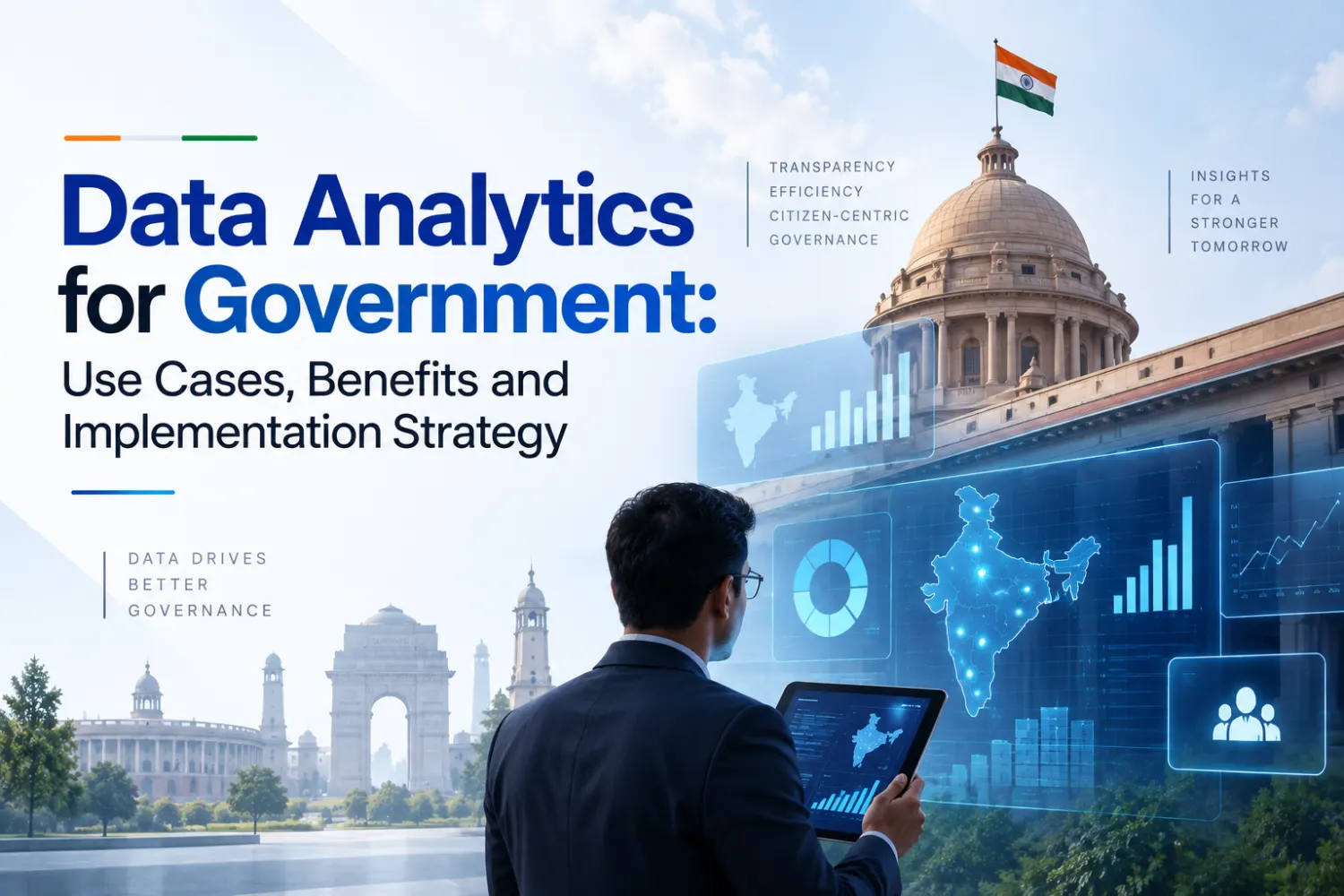
Governments generate enormous amounts of data every day—from citizen service requests and healthcare records to transportation systems, tax collections, education programs, public safety, and infrastructure projects. The challenge is no longer simply collecting this information. The real challenge is turning it into actionable intelligence.
This is where data analytics for government becomes increasingly important.
By combining data engineering, analytics, artificial intelligence, visualization, and predictive models, government departments can identify patterns, improve resource allocation, monitor programs, and make faster evidence-based decisions.
For public-sector organizations, effective analytics can help answer critical questions:
- Which public services need more resources?
- Where are infrastructure investments most urgent?
- Which government programs are delivering the desired outcomes?
- Can demand for healthcare or public transportation be predicted?
- Where are unusual transactions or potential fraud patterns emerging?
- How can citizen services become faster and more accessible?
This guide explores the major government data analytics use cases, benefits, challenges, and a practical implementation strategy for organizations looking to become more data-driven.
What Is Data Analytics for Government?
Data analytics for government refers to the systematic collection, integration, processing, analysis, and visualization of data generated by public-sector departments and government programs.
It can combine information from multiple sources, including:
- Government databases
- Citizen service portals
- Healthcare systems
- Education platforms
- Financial and tax systems
- Transportation networks
- IoT and sensor devices
- Geographic information systems (GIS)
- Surveys and public feedback
- Administrative records
Traditional reporting generally explains what happened.
Modern analytics can go further by helping government organizations understand:
What happened → Why it happened → What may happen next → What action should be considered
This progression makes analytics particularly valuable for large-scale public-sector decision-making.
Government organizations can also combine analytics with AI development services to create intelligent systems capable of identifying patterns, generating predictions, and supporting operational decisions.
Why Government Organizations Need Data Analytics
Government departments often operate across multiple systems and administrative layers. Data may exist in separate databases, spreadsheets, applications, and departmental platforms.
Without proper analytics, this creates several challenges:
1. Data Silos
Different departments may maintain separate systems, making it difficult to develop a complete view of a citizen, program, region, or service.
2. Slow Decision-Making
When officials depend heavily on manually prepared reports, important decisions can take days or weeks.
3. Limited Visibility
Large datasets can make it difficult to identify trends, anomalies, or emerging problems through traditional reporting.
4. Resource Constraints
Government organizations must allocate limited budgets, staff, infrastructure, and services where they can create the greatest public value.
5. Increasing Citizen Expectations
Citizens increasingly expect government services to be accessible, responsive, transparent, and digitally enabled.
Data analytics can help transform fragmented information into a more unified decision-support environment.
Top Data Analytics Use Cases for Government
1. Smart City and Urban Planning Analytics
Cities generate data from transportation systems, utilities, public infrastructure, environmental sensors, and citizen services.
Analytics can help authorities understand:
- Traffic patterns
- Parking demand
- Public transportation usage
- Water consumption
- Waste collection requirements
- Energy usage
- Population growth
- Infrastructure demand
For example, historical traffic data combined with real-time information can help identify congestion hotspots and support better transportation planning.
Analytics can also support long-term urban planning by revealing how population growth and development are affecting public infrastructure.
2. Healthcare and Public Health Analytics
Government healthcare organizations manage significant volumes of information related to hospitals, patients, diseases, vaccinations, medical resources, and healthcare facilities.
Data analytics can support:
- Disease surveillance
- Hospital capacity planning
- Healthcare resource allocation
- Vaccination planning
- Population health analysis
- Emergency response
- Healthcare demand forecasting
Predictive analytics can help authorities identify potential increases in healthcare demand and prepare resources accordingly.
When sensitive healthcare information is involved, analytics platforms should incorporate strong access controls, data governance, security, and privacy safeguards.
3. Education Analytics
Education departments can use analytics to understand student performance and improve educational planning.
Potential applications include:
- Student enrollment analysis
- Attendance monitoring
- Dropout-risk identification
- Teacher allocation
- School performance analysis
- Resource planning
- Examination performance trends
For example, predictive models can identify patterns associated with students who may be at greater risk of dropping out, allowing institutions to consider early intervention strategies.
4. Public Safety and Emergency Management
Data analytics can support emergency preparedness and public safety operations.
Government agencies can analyze information related to:
- Emergency calls
- Incident locations
- Weather conditions
- Natural disasters
- Fire incidents
- Road accidents
- Infrastructure failures
Geospatial analytics can help visualize incident concentrations and identify areas requiring additional resources.
Predictive models can also support scenario planning, although human oversight remains essential when analytics influence high-impact public safety decisions.
5. Tax and Revenue Analytics
Revenue departments can use analytics to identify patterns across tax filings, payments, collections, and other financial information.
Potential applications include:
- Revenue forecasting
- Tax compliance analysis
- Anomaly detection
- Payment behavior analysis
- Fraud-risk identification
- Collection optimization
Analytics doesn't necessarily replace traditional audits. Instead, it can help prioritize cases and focus human resources where further investigation may be appropriate.
6. Fraud and Anomaly Detection
Government programs can involve millions of transactions and applications, making manual review difficult.
Analytics can identify unusual patterns such as:
- Duplicate claims
- Unusual transaction behavior
- Inconsistent applications
- Abnormal payment patterns
- Suspicious account activity
- Unusual procurement behavior
Machine learning models can be trained to flag transactions or cases that differ significantly from expected patterns.
However, automated flags should generally be treated as signals for review rather than proof of wrongdoing.
7. Public Transportation Analytics
Transportation agencies can analyze data from buses, trains, roads, ticketing systems, GPS devices, and traffic sensors.
Analytics can help answer questions such as:
- Which routes experience the highest demand?
- When are peak travel periods?
- Where are delays concentrated?
- Which routes require schedule optimization?
- Where should transportation capacity be increased?
This can help agencies improve operational efficiency while creating better experiences for commuters.
8. Social Welfare Program Analytics
Government welfare programs manage large populations and complex eligibility requirements.
Analytics can support:
- Program eligibility analysis
- Benefit distribution monitoring
- Service utilization analysis
- Resource allocation
- Program outcome measurement
- Fraud and duplicate-claim detection
By analyzing program performance, authorities can identify where services are reaching intended beneficiaries and where operational improvements may be required.
9. Agriculture and Rural Development Analytics
Agricultural departments can combine government records with weather, satellite, soil, crop, and market information.
Potential applications include:
- Crop monitoring
- Yield forecasting
- Irrigation planning
- Weather-risk assessment
- Agricultural subsidy analysis
- Market trend analysis
- Rural development planning
Combining geographic and historical data can help authorities understand regional agricultural patterns and improve planning.
10. Infrastructure and Asset Management
Government agencies manage roads, bridges, public buildings, utilities, transportation assets, and other infrastructure.
Analytics can help monitor:
- Asset condition
- Maintenance requirements
- Project progress
- Budget utilization
- Construction timelines
- Infrastructure demand
Predictive maintenance models can potentially identify assets that may require attention before failures occur.
This can shift infrastructure management from a purely reactive model toward a more proactive approach.
Key Benefits of Data Analytics for Government
Better Evidence-Based Decision-Making
Instead of relying primarily on assumptions or static reports, policymakers can use measurable data to evaluate situations and compare potential approaches.
Improved Resource Allocation
Analytics can help identify where staff, funding, infrastructure, and public services may have the greatest impact.
Faster Government Services
Real-time dashboards and automated reporting can reduce the time required to collect and interpret information.
Greater Operational Efficiency
Analytics can uncover bottlenecks, repetitive processes, underutilized resources, and operational inefficiencies.
Better Program Evaluation
Government agencies can compare planned objectives with actual outcomes and identify areas for improvement.
Improved Transparency
Well-designed public dashboards can make selected government information easier for citizens and stakeholders to understand.
Predictive Decision Support
Predictive analytics can help organizations prepare for potential demand, risks, and operational changes rather than responding only after an event occurs.
Data Analytics vs. Traditional Government Reporting
Traditional reporting and modern analytics serve different purposes.
| Traditional Reporting | Data Analytics |
|---|---|
| Focuses on historical information | Uses historical and real-time information |
| Primarily describes what happened | Explores what happened and why |
| Often relies on static reports | Uses interactive dashboards |
| Manual analysis is common | Automation can accelerate analysis |
| Limited forecasting | Supports predictive modeling |
| Department-specific information | Can integrate cross-department data |
| Periodic decision support | Can provide near-real-time insights |
The objective is not necessarily to eliminate traditional reporting. Instead, analytics can extend reporting into a more dynamic decision-support capability.
How to Implement Data Analytics in Government
Successful government analytics requires more than purchasing a dashboard or implementing an AI model. It requires a structured approach covering data, technology, people, governance, and measurable outcomes.
Step 1: Define the Government's Business Problem
Start with the problem—not the technology.
Examples include:
- Reducing emergency response times
- Improving public transportation
- Increasing tax compliance
- Optimizing healthcare resources
- Improving welfare program delivery
A clearly defined problem creates a stronger foundation for selecting the right analytics approach.
Step 2: Assess Existing Data
Identify:
- What data already exists?
- Where is it stored?
- Who owns it?
- How frequently is it updated?
- How accurate is it?
- Can different datasets be connected?
- Are there privacy or regulatory restrictions?
This assessment helps identify data gaps before major technology investments are made.
Government organizations can benefit from data management systems and modern data architectures that bring fragmented information together for analytics and reporting.
Step 3: Establish Data Governance
Data governance is critical in the public sector.
A governance framework should define:
- Data ownership
- Data access
- Data quality standards
- Retention policies
- Privacy requirements
- Security controls
- Data-sharing responsibilities
- Audit processes
Strong governance helps ensure that analytics systems remain trustworthy and accountable.
Step 4: Build the Data Architecture
Depending on requirements, the architecture may include:
- Data warehouses
- Data lakes
- ETL/ELT pipelines
- APIs
- Cloud infrastructure
- Data integration platforms
- Analytics platforms
- Business intelligence dashboards
The architecture should be scalable enough to support increasing data volumes and future analytical requirements.
Cloud solutions can also help government organizations scale infrastructure while supporting centralized data and analytics environments, subject to applicable procurement, security, residency, and regulatory requirements.
Step 5: Start With a High-Value Pilot
Government organizations should avoid trying to transform every department simultaneously.
Instead, select one use case with:
- Clear business value
- Available data
- Measurable outcomes
- Manageable implementation complexity
- Strong stakeholder support
A successful pilot can demonstrate value before expanding the program.
Step 6: Build Analytics and AI Models
Depending on the use case, solutions may include:
- Descriptive analytics
- Diagnostic analytics
- Predictive analytics
- Prescriptive analytics
- Machine learning
- Anomaly detection
- Forecasting
- Natural language processing
The technology should be selected based on the problem rather than using AI simply because it is available.
Step 7: Develop Decision-Making Dashboards
Analytics becomes significantly more useful when decision-makers can easily understand the results.
A government analytics dashboard might display:
- KPIs
- Geographic trends
- Performance indicators
- Alerts
- Forecasts
- Program outcomes
- Budget utilization
- Service demand
The interface should be designed for the people making decisions—not only for technical analysts.
Step 8: Validate and Measure Results
Every analytics initiative should have measurable success criteria.
Possible metrics include:
- Processing time reduction
- Cost savings
- Service delivery improvements
- Forecast accuracy
- Response-time improvements
- Resource utilization
- Citizen satisfaction
- Fraud-risk identification
Measuring results helps determine whether the project should be expanded, redesigned, or discontinued.
Step 9: Scale Across Departments
Once the pilot demonstrates measurable value, the organization can expand the architecture and analytics capabilities to other departments.
A mature government data strategy may eventually connect multiple areas such as:
Healthcare + Education + Transportation + Finance + Public Safety + Citizen Services
This can create a broader data-driven ecosystem while maintaining appropriate access controls and governance boundaries.
Challenges of Government Data Analytics
Although the benefits are significant, public-sector analytics projects can face several challenges.
Data Quality
Incomplete, outdated, duplicated, or inconsistent data can reduce the reliability of analytical results.
Legacy Systems
Older government applications may not easily integrate with modern analytics platforms.
Data Silos
Different departments may use different formats, databases, identifiers, and governance processes.
Privacy and Security
Government datasets may contain sensitive personal, financial, or operational information that requires strict protection.
Skills Gap
Successful analytics programs require expertise in data engineering, analytics, cloud architecture, cybersecurity, AI, and domain-specific decision-making.
Change Management
Even technically successful systems can fail to deliver value if employees do not trust or adopt them.
Model Bias and Explainability
When machine learning is used for high-impact decisions, organizations should assess data quality, fairness, explainability, human oversight, and potential unintended consequences.
Best Practices for Government Data Analytics
For a sustainable analytics strategy, government organizations should consider these principles:
1. Start With Outcomes
Define the public-service outcome before selecting technology.
2. Build Data Quality Into the Process
Analytics is only as reliable as the data supporting it.
3. Prioritize Security
Use encryption, authentication, authorization, auditing, and appropriate access controls.
4. Design for Interoperability
APIs and standardized data structures can make it easier to connect systems.
5. Keep Humans in the Loop
Analytics should support informed decisions, especially when decisions can significantly affect citizens.
6. Make Insights Explainable
Decision-makers should understand where important insights and predictions come from.
7. Scale Incrementally
Pilot → Validate → Improve → Scale.
8. Continuously Monitor Models
Predictive models can degrade when data patterns change. Regular monitoring and retraining may be necessary.
The Role of AI in Government Data Analytics
Artificial intelligence is expanding what government analytics platforms can do.
Traditional analytics might tell an agency that service demand increased by 20%.
AI-enabled analytics can potentially help determine:
- What factors contributed to the increase?
- Which areas are likely to experience higher demand next?
- Which resources may be required?
- Which operational actions could improve service delivery?
AI can also support natural-language interfaces, automated document processing, anomaly detection, forecasting, and intelligent decision-support systems.
Organizations exploring these capabilities can combine AI consulting services with data engineering and analytics to identify practical use cases before making significant investments. True Value Infosoft's AI consulting approach includes readiness assessment, use-case prioritization, data and infrastructure consulting, and implementation planning.
How True Value Infosoft Can Help With Government Data Analytics
A successful government analytics platform requires more than a visualization layer. It needs reliable data pipelines, scalable software, secure integrations, analytics capabilities, and a clear implementation roadmap.
True Value Infosoft provides technology capabilities across AI development, software development, data solutions, AI integration, and AI consulting. Its public website highlights AI solutions, custom software, data management systems, AI integration, and strategic AI consulting capabilities.
For organizations starting from an existing technology environment, AI integration services can connect AI capabilities with existing applications and workflows while building the required data pipelines and middleware.
For larger initiatives, AI product development can support the development of scalable analytics products and intelligent platforms from strategy through deployment.
The right approach depends on the department's data maturity, objectives, infrastructure, security requirements, and expected outcomes.
Conclusion
Data analytics for government is becoming an important foundation for modern public administration. From smarter cities and healthcare planning to fraud detection, transportation optimization, education, infrastructure, and citizen services, analytics can help government organizations turn complex datasets into meaningful insights.
However, successful implementation is not simply about adopting AI or creating dashboards. The strongest programs combine quality data, secure architecture, effective governance, skilled teams, measurable objectives, and human-centered decision-making.
Government organizations that approach analytics strategically can build a stronger foundation for evidence-based policymaking and more efficient public services.
If your organization is exploring a government analytics platform, AI-powered decision-support system, or data modernization initiative, True Value Infosoft can help evaluate the opportunity, define a practical technology roadmap, and build scalable digital solutions.
Ready to turn government data into actionable intelligence? Connect with True Value Infosoft to discuss your data analytics and AI requirements.