Introduction
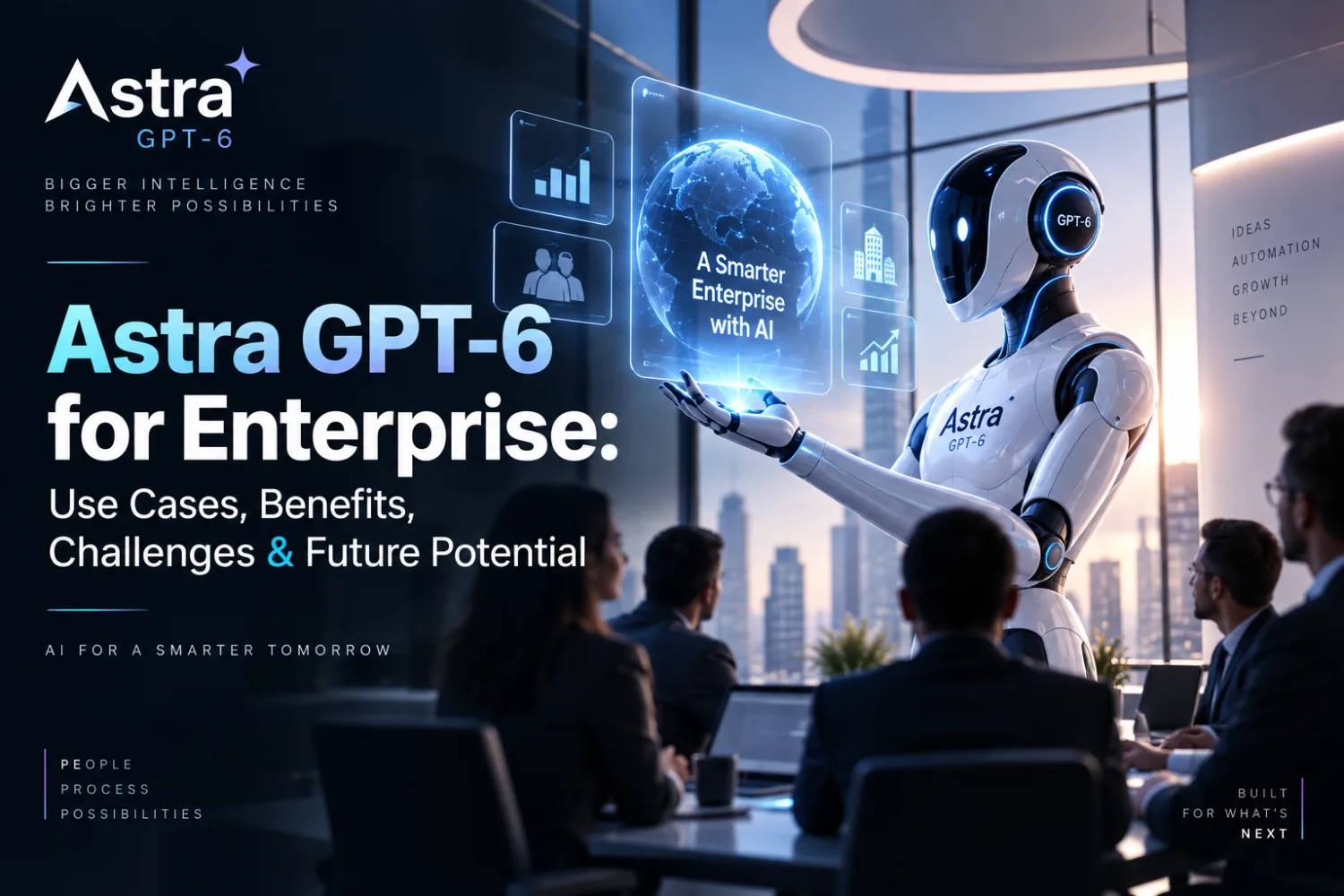
Enterprise AI is entering a new phase.
For years, businesses primarily used AI for chatbots, content generation, recommendations, analytics, and other narrowly defined tasks. The latest generation of AI models is moving toward something much broader: systems capable of reasoning through complex problems, using software tools, working across multiple steps, and completing professional tasks with greater autonomy.
GPT-6 Astra represents this shift.
Introduced by OpenAI in September 2026, GPT-6 Astra is positioned as its most capable model for complex end-to-end work, with capabilities spanning computer use, browsing, software engineering, cybersecurity, science, research, and professional workflows. It can also work with tools and produce documents, spreadsheets, presentations, and other business outputs.
For enterprises, the opportunity is bigger than simply using a more powerful chatbot.
Astra can become part of business processes—helping employees research information, update systems, analyze data, automate repetitive computer tasks, support customers, assist developers, and coordinate multi-step workflows.
But enterprise adoption also introduces important questions around security, governance, cost, integration, reliability, data protection, and human oversight.
This guide explores how businesses can use Astra, where it can create value, what challenges organizations should consider, and what its future could mean for enterprise software.
What Is GPT-6 Astra?
GPT-6 Astra is OpenAI's latest flagship AI model, designed for complex reasoning and end-to-end professional work.
According to OpenAI, Astra is state-of-the-art across areas including:
- Computer use
- Browsing
- Software engineering
- Cybersecurity
- Scientific work
- Professional workflows
- Complex reasoning
- Document creation
- Research
It is also designed to execute multi-step tasks using tools rather than simply generating a response.
For developers, the model is available through the OpenAI API as gpt-6-astra, with support for tool use and long-context workflows. OpenAI lists a context window of up to 1.05 million tokens and up to 128,000 output tokens.
This makes Astra particularly interesting for enterprises dealing with large volumes of information and complex workflows.
Why GPT-6 Astra Matters for Enterprises
Enterprise organizations have a fundamentally different set of requirements from individual AI users.
They need AI that can work with:
- Internal business applications
- Customer databases
- CRM platforms
- ERP systems
- Documents
- Spreadsheets
- APIs
- Knowledge bases
- Business workflows
- Security systems
Astra's ability to combine reasoning with tool use makes it relevant to this environment.
Instead of:
Employee → AI question → AI answer
enterprises can move toward:
Business Goal → AI Reasoning → Business Systems → Actions → Verification → Human Oversight
This is a significant change in how businesses can think about AI software.
GPT-6 Astra Enterprise Use Cases
1. AI-Powered Customer Support
Customer support is one of the most practical areas for enterprise AI.
Astra can help businesses understand customer requests, retrieve relevant information, and perform appropriate actions through connected tools.
For example:
Customer Request
↓
AI Understands Intent
↓
Retrieve Customer Information
↓
Check Order / Account / Service
↓
Generate Response
↓
Update CRM
↓
Escalate if Necessary
This goes beyond a traditional FAQ chatbot.
Businesses can build AI Customer Support Solutions that combine conversational intelligence with CRM and workflow automation.
2. AI Sales Agents
Sales teams spend considerable time on repetitive activities such as lead qualification, CRM updates, research, follow-ups, and scheduling.
An enterprise AI sales agent can potentially assist with:
- Lead qualification
- Prospect research
- CRM updates
- Email drafting
- Meeting preparation
- Follow-up scheduling
- Sales-data analysis
- Proposal preparation
Astra's ability to perform multi-step computer tasks makes this type of workflow increasingly practical. OpenAI specifically describes computer-use capabilities such as updating CRM records and organizing calendars.
Businesses can combine this with AI Sales Agent Development to create workflows tailored to their sales processes.
3. Software Development and Engineering
Software engineering is another major enterprise use case.
Astra can assist with:
- Code generation
- Code analysis
- Debugging
- Software testing
- Documentation
- Repository research
- Frontend development
- Technical problem solving
OpenAI positions Astra as a state-of-the-art model for software engineering and computer use.
An enterprise development workflow could look like:
Developer Request
↓
Astra Analyzes Repository
↓
Identifies Required Changes
↓
Generates Code
↓
Runs Tests
↓
Analyzes Errors
↓
Suggests or Applies Fixes
↓
Developer Review
This can help developers spend more time on architecture and product decisions rather than repetitive implementation work.
4. AI-Powered Business Research
Enterprise employees often spend hours collecting and organizing information.
Astra can assist with:
- Market research
- Competitor research
- Industry analysis
- Internal research
- Data gathering
- Report generation
- Research summaries
Its browsing and research capabilities make it suitable for workflows where information must be gathered from multiple sources and transformed into a structured business output.
For example:
Research Objective
↓
Search Multiple Sources
↓
Collect Relevant Information
↓
Compare Findings
↓
Identify Patterns
↓
Create Executive Summary
5. Document and Report Automation
Enterprises produce thousands of documents every year.
AI can help automate parts of:
- Business reports
- Proposals
- Presentations
- Financial summaries
- Meeting documentation
- Research reports
- Internal documentation
OpenAI states that Astra can create documents, spreadsheets, and presentations while following provided templates and instructions.
This opens the door to AI-powered document automation where employees provide objectives and business context while AI handles significant portions of preparation.
6. Data Analysis and Business Intelligence
Businesses have large amounts of structured and unstructured data.
Astra can assist with:
- Data interpretation
- Spreadsheet analysis
- Trend identification
- Report creation
- Data visualization
- Business summaries
- Analytical workflows
For example:
Sales Data
↓
Astra Analyzes Dataset
↓
Identifies Trends
↓
Creates Visualizations
↓
Generates Management Summary
↓
Recommends Areas for Investigation
The final business decision should remain with qualified people, particularly where financial or operational consequences are significant.
7. AI for HR and Recruitment
Human resources departments can use enterprise AI for administrative and coordination-heavy workflows.
Potential applications include:
- Resume analysis
- Candidate communication
- Interview scheduling
- Job-description preparation
- Candidate matching
- Recruitment analytics
- Employee FAQ support
An AI recruitment workflow might be:
Candidate Application
↓
Resume Processing
↓
Candidate Matching
↓
Recruiter Review
↓
Interview Scheduling
↓
Candidate Communication
This can complement an AI Recruitment Software platform while keeping important hiring decisions under human control.
8. AI-Powered Cybersecurity
Cybersecurity is an especially interesting area for advanced AI.
Astra's capabilities include cybersecurity, and OpenAI describes the model as reaching its Critical cybersecurity capability threshold.
Enterprise applications may include:
- Security-log analysis
- Threat investigation
- Vulnerability analysis
- Incident-response assistance
- Security research
- Alert prioritization
- Defensive security automation
However, cybersecurity is also an area where powerful AI introduces significant risks.
OpenAI's safety overview notes that Astra can discover previously unknown security flaws and develop exploits with appropriate tools and access. This makes strict authorization, isolation, monitoring, and governance especially important.
9. AI-Powered Internal Knowledge Assistants
Large organizations often have information spread across:
- Policies
- PDFs
- Internal documents
- Knowledge bases
- Product documentation
- Training material
- SOPs
Employees may spend significant time searching for information.
Astra can be integrated with enterprise knowledge systems to provide contextual answers.
For example:
"What is our process for approving a new vendor?"
The AI system can retrieve relevant approved documentation and provide a concise answer.
This can be strengthened using RAG and Knowledge Base Solutions, allowing the AI system to work with controlled enterprise information rather than relying solely on model knowledge.
10. AI for Business Operations
Astra can potentially act as an intelligence layer across multiple operational systems.
Consider an operations workflow:
Incoming Request
↓
Astra Understands Request
↓
Checks Business Rules
↓
Accesses Relevant Systems
↓
Performs Required Actions
↓
Verifies Result
↓
Updates Business Records
This could support processes such as:
- Customer onboarding
- Order management
- Appointment management
- Internal approvals
- Administrative workflows
- Reporting
- Data entry
- Operations coordination
The exact level of autonomy should be determined by the risk and importance of each action.
11. AI for Healthcare Enterprises
Healthcare organizations can explore Astra for carefully controlled administrative and operational use cases.
Potential applications include:
- Patient communication
- Appointment assistance
- Administrative workflows
- Document organization
- Knowledge retrieval
- Scheduling
- Healthcare staff assistance
However, healthcare AI requires stronger controls around privacy, data security, accuracy, clinical safety, and applicable regulations.
AI should support qualified professionals rather than independently making high-impact clinical decisions.
Organizations exploring this space can combine Healthcare Software Development with AI integration and automation expertise.
12. AI in Hospitality
Hotels and hospitality businesses can use advanced AI to create intelligent guest-service workflows.
For example:
Guest Message
↓
Astra Understands Request
↓
Checks Hotel Information
↓
Checks Booking / Availability
↓
Performs Authorized Action
↓
Responds to Guest
↓
Updates Hotel System
Potential applications include:
- Booking assistance
- Guest communication
- Concierge services
- Room-service requests
- Restaurant reservations
- Local recommendations
- Post-stay feedback
When combined with WhatsApp Automation, AI can become part of a complete guest communication ecosystem.
GPT-6 Astra and AI Agents
One of the biggest enterprise opportunities is the development of AI agents.
Traditional AI:
Ask → Answer
AI agent:
Goal → Reason → Plan → Use Tools → Execute → Verify
For example:
"Prepare tomorrow's sales meeting."
An AI agent could potentially:
- Access the sales CRM.
- Identify important opportunities.
- Review recent customer interactions.
- Analyze pipeline changes.
- Create a summary.
- Prepare a presentation.
- Add relevant information to a meeting document.
- Schedule or organize follow-up tasks.
This is the transition from generative AI to agentic AI.
GPT-6 Astra and Enterprise Workflow Automation
Astra becomes even more valuable when integrated with workflow automation.
For example:
Customer Email
↓
AI Understands Request
↓
Workflow Automation
↓
CRM Update
↓
Database Update
↓
Customer Notification
Tools such as APIs, enterprise applications, and workflow automation platforms can connect AI reasoning with business actions.
Businesses can use Business Process Automation to turn repetitive manual workflows into structured, intelligent processes.
Benefits of GPT-6 Astra for Enterprises
1. Higher Employee Productivity
AI can automate repetitive knowledge-work tasks and assist employees with complex workflows.
2. Faster Business Operations
Tasks that previously required multiple manual steps can potentially be completed much faster.
3. Better Access to Information
Employees can interact with enterprise knowledge using natural language.
4. Improved Customer Experiences
AI-powered systems can provide faster and more contextual customer assistance.
5. Automation at Scale
Businesses can apply AI across departments and workflows rather than limiting it to individual users.
6. Better Software Development
Developers can use AI to accelerate coding, testing, debugging, and technical research.
7. New Digital Workforce Models
AI agents can increasingly handle structured digital tasks while employees focus on judgment, relationships, creativity, and strategy.
Challenges of GPT-6 Astra for Enterprise
Advanced AI also introduces new challenges.
1. Data Privacy
Enterprise AI applications may process sensitive customer, financial, employee, or operational data.
Organizations need appropriate data handling policies, access controls, security measures, and vendor assessments.
2. Security Risks
A highly capable AI with access to enterprise tools can create significant risks if permissions are poorly designed.
A compromised or misconfigured agent could potentially perform unintended actions.
The principle should be:
Give AI only the access it actually needs.
3. Hallucinations and Incorrect Outputs
Even highly capable models can produce incorrect information.
Important workflows should include:
- Validation
- Grounded information
- Human review
- Business rules
- Monitoring
4. Excessive Autonomy
Not every business process should be fully automated.
For example:
Low Risk: Generate an internal summary.
Medium Risk: Update a CRM record.
Higher Risk: Issue a refund.
Critical: Make a high-impact business or clinical decision.
The higher the potential impact, the stronger the required controls should be.
5. Integration Complexity
Enterprise environments rarely consist of a single application.
Businesses may need to integrate:
- CRM
- ERP
- HR systems
- Databases
- APIs
- Communication platforms
- Cloud applications
- Internal software
This is why AI Integration Services can be as important as the AI model itself.
GPT-6 Astra Cost Considerations
The cost of using Astra depends on how it is deployed and the volume and complexity of workloads.
OpenAI currently lists API pricing of $10 per million input tokens and $50 per million output tokens for standard GPT-6 Astra API usage. OpenAI also lists additional considerations for large prompts and tool-specific usage.
However, token price should not be the only consideration.
Businesses should calculate:
AI Cost + Integration Cost + Infrastructure + Monitoring + Development + Maintenance
A more expensive model can still be economically attractive if it completes a task substantially faster or reduces the amount of manual work required.
Therefore, enterprises should evaluate cost per completed business task, not simply cost per token.
How Businesses Can Prepare for GPT-6 Astra
Step 1: Identify High-Value Workflows
Look for processes that are:
- Repetitive
- Time-consuming
- Digital
- Data-driven
- Clearly measurable
Step 2: Start With a Pilot
Instead of deploying AI across the entire organization, choose one workflow.
Examples:
- Sales qualification
- Customer support
- Document processing
- Internal knowledge search
- Software development assistance
Step 3: Map Required Integrations
Determine which systems the AI needs to access.
Step 4: Define Permissions
Create clear rules for what the AI can and cannot do.
Step 5: Add Human Oversight
Define when employees must approve, review, or override AI actions.
Step 6: Measure Results
Track metrics such as:
- Time saved
- Task completion
- Accuracy
- Error rates
- Customer satisfaction
- Employee productivity
- Cost per task
Step 7: Scale Gradually
Once a pilot demonstrates value, expand to additional workflows.
GPT-6 Astra vs Traditional Enterprise Software
Traditional software generally follows predefined instructions.
AI-powered enterprise software can interpret more complex requests and adapt to changing inputs.
The future isn't necessarily:
AI replacing traditional software
It is more likely:
Traditional Software + AI Intelligence + Automation + Human Oversight
For example, a CRM remains responsible for storing customer data.
An AI agent can sit on top of that CRM and help employees understand and act on the information.
This creates a more intelligent interface to existing enterprise systems.
The Future Potential of GPT-6 Astra
GPT-6 Astra could accelerate a broader shift toward AI-native enterprise applications.
Instead of building software where users manually navigate dozens of screens, businesses may increasingly build systems where users describe their objectives in natural language.
Imagine telling an enterprise system:
"Find our highest-value customers at risk of leaving and prepare a retention plan for each."
The system could potentially:
- Analyze CRM data
- Identify relevant customers
- Review interactions
- Segment risks
- Prepare recommendations
- Create reports
- Assign tasks
The interface changes from:
Click → Search → Filter → Export → Analyze
to:
Describe Goal → AI Executes Workflow
This doesn't eliminate traditional software.
It changes how people interact with it.
Multi-Agent Enterprise Systems
Another potential development is the rise of specialized AI agents.
For example:
Sales Agent
Handles prospect research and lead qualification.
Customer Support Agent
Handles customer inquiries.
Finance Agent
Assists with financial workflows.
HR Agent
Supports recruitment and employee operations.
Operations Agent
Coordinates internal workflows.
These agents could potentially communicate with one another through controlled systems.
The result could be a network of specialized digital workers operating across an organization.
Important Considerations for Responsible Enterprise AI
Businesses adopting advanced AI should establish governance early.
Important areas include:
Access Control
Limit AI access to necessary systems.
Auditability
Maintain records of important AI actions.
Human Oversight
Require review for sensitive decisions.
Data Governance
Define how business information can be used.
Security Testing
Regularly test AI applications and integrations.
Monitoring
Track performance, errors, unusual behavior, and unexpected actions.
Clear Accountability
Organizations should know who owns the AI system and its outcomes.
OpenAI has also introduced additional safety monitoring for Astra, including mechanisms intended to detect situations where agents may not have interpreted instructions correctly.
How True Value Infosoft Can Help Businesses Adopt Advanced AI
Implementing an enterprise AI solution requires more than selecting an advanced model.
Businesses need:
- AI strategy
- Application development
- API integration
- Data integration
- Workflow automation
- User-interface development
- Security
- Testing
- Deployment
- Ongoing support
True Value Infosoft provides AI Development Services that can help businesses explore AI-powered applications, intelligent automation, AI agents, generative AI, chatbots, RAG solutions, and other modern AI capabilities.
Its AI Integration Services can connect AI technologies with business applications, APIs, CRM/ERP systems, SaaS platforms, data pipelines, and other enterprise infrastructure.
For businesses looking to build complete AI-powered products, Custom Software Development can provide the application layer required to turn an AI capability into a practical business solution.
True Value Infosoft can also support organizations looking for AI Developer Services to build and integrate AI solutions according to their specific business requirements.
The objective should be to use advanced AI where it creates measurable value—not simply because the technology is new.
Conclusion
GPT-6 Astra represents an important evolution in enterprise AI.
Its capabilities extend beyond conversational AI into reasoning, computer use, software engineering, research, cybersecurity, professional workflows, and multi-step task execution.
For businesses, this creates opportunities to build AI-powered sales agents, customer-support systems, internal knowledge assistants, workflow automation, software-development tools, intelligent operations platforms, and other enterprise applications.
But advanced capability also requires advanced governance.
The organizations most likely to benefit will be those that combine:
Powerful AI + Reliable Business Data + Secure Integrations + Automation + Human Oversight
GPT-6 Astra should therefore be viewed not simply as another AI model, but as a potential intelligence layer for enterprise software and business operations.
True Value Infosoft can help businesses explore this opportunity through AI development, enterprise integration, workflow automation, and custom software development.
Ready to explore how GPT-6 Astra could transform your business operations? Contact True Value Infosoft and start planning your enterprise AI strategy for 2026.