Introduction
The legal industry has traditionally been known for its heavy dependence on manual processes—reviewing documents, researching case laws, drafting contracts, and ensuring compliance. These tasks often demand significant time, precision, and human effort.
But today, Artificial Intelligence (AI) is transforming legal operations.
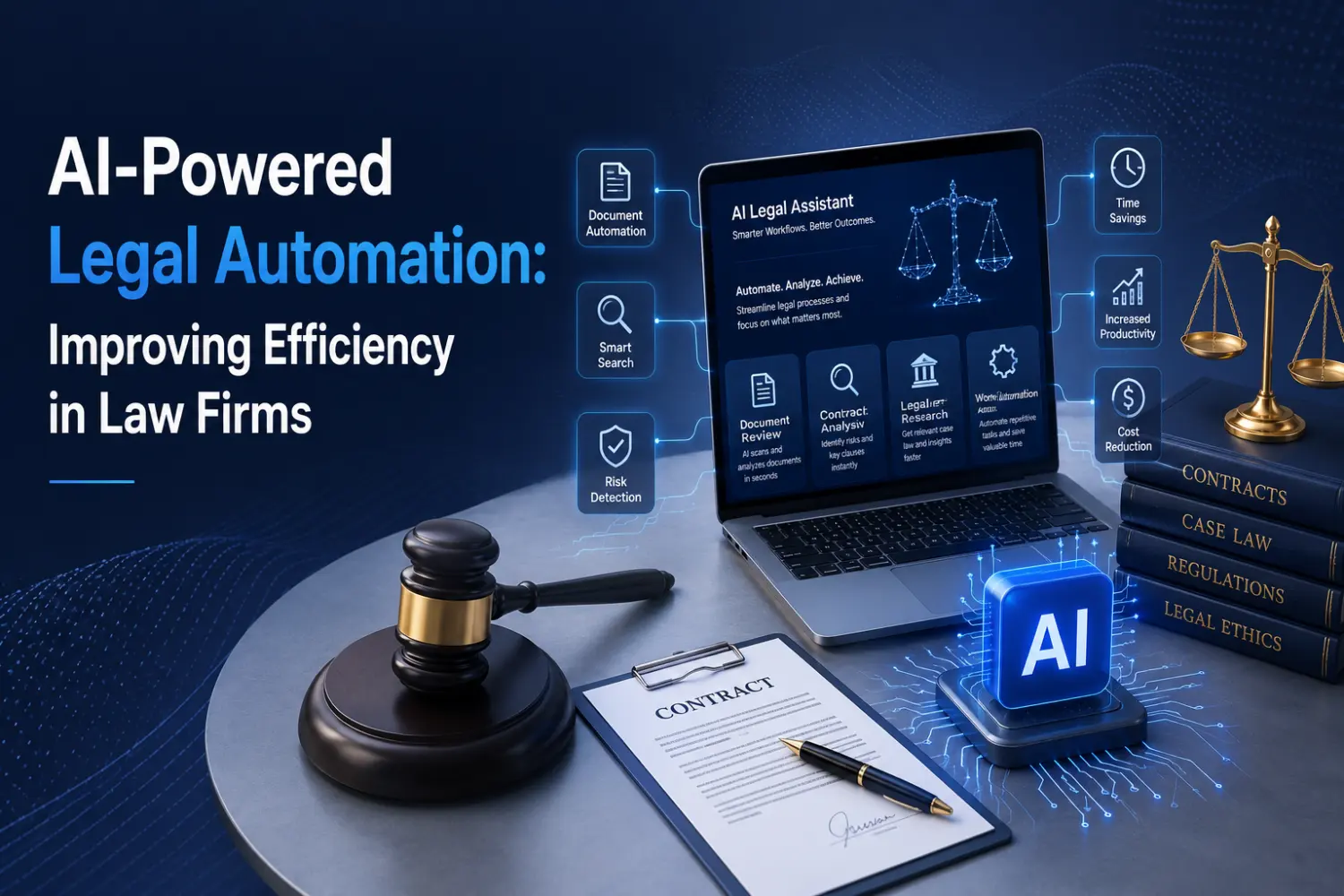
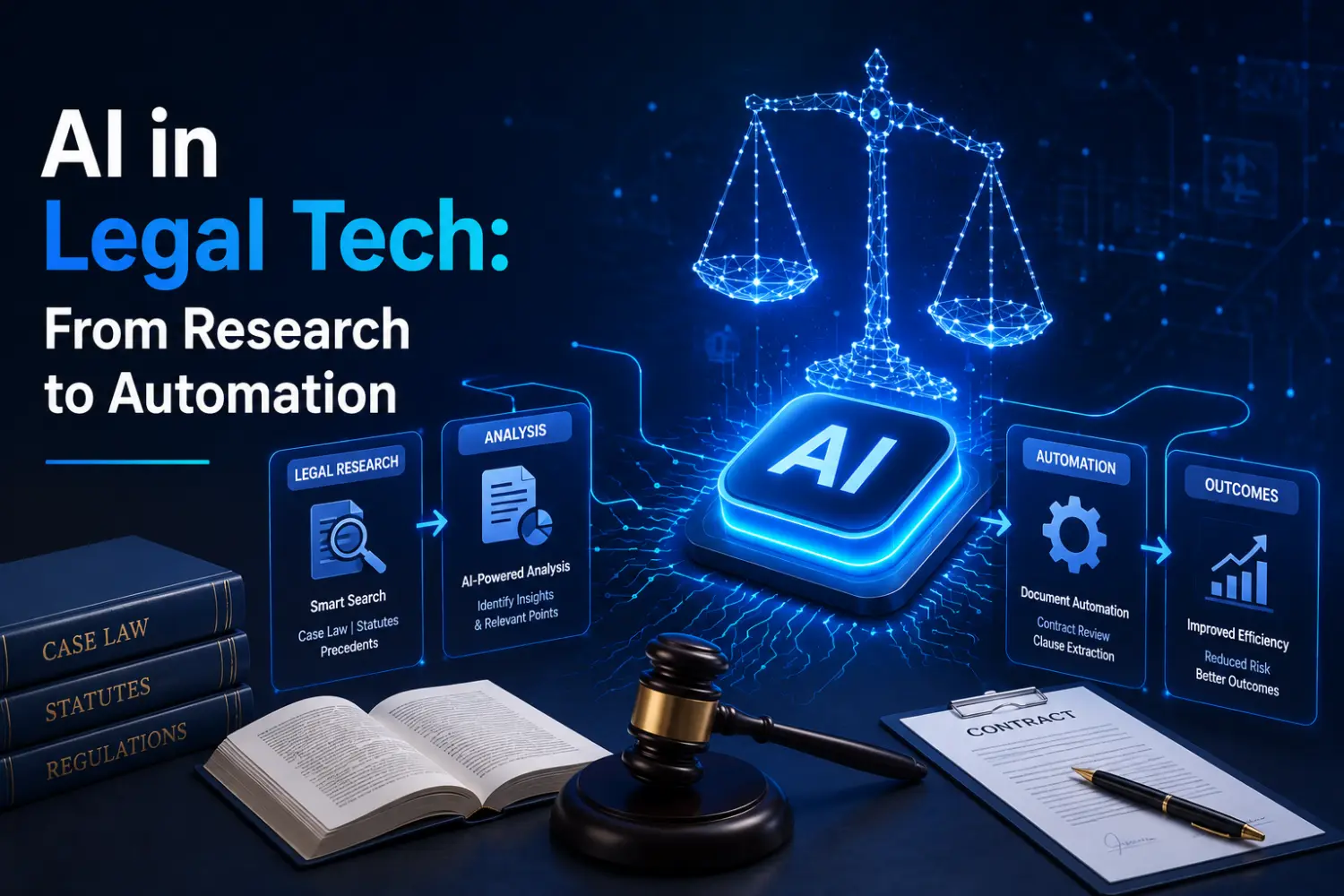
From legal research to intelligent automation, AI is helping law firms, corporate legal departments, and compliance teams work faster, smarter, and more accurately. Rather than replacing lawyers, AI is becoming a powerful assistant that handles repetitive tasks and enables legal professionals to focus on strategy, analysis, and client relationships.
At True Value Infosoft, we help businesses leverage AI-powered solutions to modernize traditional workflows—including legal and compliance operations.
What is AI in Legal Tech?
AI in Legal Tech refers to the use of technologies such as:
- Machine Learning (ML)
- Natural Language Processing (NLP)
- Generative AI
- Predictive Analytics
- Intelligent Automation
These technologies analyze large volumes of legal data, identify patterns, generate insights, and automate repetitive legal tasks.
In simple terms, AI helps legal teams move from manual work to intelligent workflows.
The legal industry is rapidly adopting AI-driven tools to improve efficiency, reduce costs, and minimize human error. Recent legal tech trends show AI is increasingly used not just for automation but also for decision support and risk analysis.
The Traditional Challenges in Legal Operations
Before AI adoption, legal teams commonly faced challenges such as:
Time-Consuming Legal Research
Finding relevant case laws, statutes, and precedents can take hours or even days.
Massive Document Volume
Contracts, agreements, court filings, policies, and compliance documents create overwhelming workloads.
Human Errors
Manual review increases the risk of missed clauses, inconsistencies, or compliance issues.
High Operational Costs
Routine legal tasks consume expensive billable hours.
Slow Turnaround
Manual approvals and document processing delay business decisions.
These challenges create inefficiencies that AI can significantly reduce.
How AI is Transforming Legal Tech
1. AI-Powered Legal Research
Legal research is one of the biggest areas AI has improved.
Traditional legal research requires lawyers to manually search through databases for relevant laws and precedents. AI changes this by:
- Understanding natural language queries
- Searching millions of records instantly
- Summarizing relevant judgments
- Finding precedent-based insights
- Suggesting related cases
Example:
Instead of searching with complex keywords, a lawyer can ask:
“Show me cases related to contract breach in software agreements.”
AI tools can deliver relevant cases within seconds.
This dramatically reduces research time while improving accuracy. AI research platforms are increasingly used to surface citations and summarize case law faster than traditional search alone.
2. Contract Review & Analysis
Contract review is repetitive and detail-heavy.
AI can automatically analyze contracts and detect:
- Missing clauses
- Risky language
- Compliance violations
- Renewal dates
- Payment obligations
- Liability issues
Benefits include:
- Faster review
- Reduced risk
- Better compliance
- Automated alerts
This is especially useful for enterprises managing hundreds or thousands of contracts.
3. Legal Document Automation
Document drafting consumes significant legal hours.
AI can automate the creation of:
- NDAs
- Employment agreements
- Vendor contracts
- Compliance reports
- Legal notices
- Policy documents
Using templates and AI-generated suggestions, legal teams can draft documents in minutes instead of hours.
This improves productivity while maintaining consistency.
Many modern law firms report substantial time savings from AI-driven document workflows.
4. Compliance Monitoring
Regulations constantly evolve across industries such as:
Missing compliance deadlines can result in:
- Finance
- Healthcare
- Insurance
- Government
- SaaS
Missing regulatory changes can be costly.
AI helps by:
- Monitoring regulatory updates
- Flagging compliance risks
- Generating alerts
- Tracking policy changes
- Maintaining audit trails
This makes compliance proactive rather than reactive.
5. E-Discovery Automation
In litigation, lawyers often review thousands of files including:
- Emails
- Chats
- PDFs
- Internal records
- Attachments
Manual review is slow and expensive.
AI accelerates e-discovery by:
- Classifying documents
- Identifying relevant evidence
- Detecting anomalies
- Prioritizing high-risk content
This reduces weeks of work to hours.
6. Predictive Legal Analytics
AI can analyze historical case outcomes and legal trends to estimate probabilities such as:
- Likelihood of winning a case
- Settlement probability
- Judge behavior patterns
- Litigation cost estimates
- Risk scoring
These insights help firms make data-driven legal decisions.
AI in legal tech is moving beyond automation into predictive intelligence and recommendation systems.
Benefits of AI in Legal Tech
Organizations adopting AI in legal workflows experience major advantages.
Increased Efficiency
Routine tasks are completed much faster.
Reduced Costs
Automation lowers operational expenses.
Improved Accuracy
AI reduces manual oversight errors.
Better Risk Management
Potential issues are flagged earlier.
Faster Decision-Making
Teams access insights instantly.
Higher Productivity
Lawyers focus on high-value strategic work.
Recent industry adoption shows legal teams increasingly use AI to reduce repetitive workload while improving service delivery.
Will AI Replace Lawyers?
A common concern is:
“Will AI replace lawyers?”
The short answer is: No.
AI cannot replace human judgment, ethics, negotiation, advocacy, and emotional intelligence.
Instead, AI handles repetitive tasks while lawyers focus on:
- Strategy
- Client communication
- Court representation
- Negotiation
- Complex legal reasoning
Think of AI as a co-pilot for lawyers, not a replacement.
Challenges of AI in Legal Tech
Despite the benefits, AI adoption comes with challenges.
Data Privacy
Legal data is highly sensitive.
AI Hallucinations
Generative AI can occasionally produce inaccurate outputs.
Regulatory Concerns
AI usage must comply with legal standards.
Trust & Adoption
Law firms need confidence in AI systems.
Because of this, human review remains essential—especially in high-stakes legal decisions. AI in law requires strong governance and auditability.
The Future of AI in Legal Technology
The future of legal tech is shifting from simple automation to intelligent legal ecosystems.
Emerging trends include:
- AI legal assistants
- Voice-enabled legal search
- AI agents for legal workflows
- Autonomous contract lifecycle management
- Retrieval-Augmented Generation (RAG) systems
- Custom enterprise legal copilots
Soon, legal teams will use AI not only for automation but for strategic intelligence and decision support.
How True Value Infosoft Helps Legal Businesses with AI
At True Value Infosoft, we build intelligent AI-powered solutions tailored to business needs.
Our expertise includes:
- AI/ML Solutions
- Legal Workflow Automation
- Custom Enterprise AI Tools
- Intelligent Document Processing
- RAG-based Knowledge Systems
- Predictive Analytics
- Secure Cloud Infrastructure
We help law firms and enterprises transform traditional legal operations into modern AI-driven workflows.
Whether you want to automate document review, build an AI legal assistant, or improve compliance processes, our team can help.
Conclusion
AI is revolutionizing legal technology.
What once required hours of manual effort can now be completed in minutes with AI-powered systems. From legal research and document analysis to compliance and predictive insights, AI is creating faster, smarter, and more scalable legal operations.
The future belongs to legal teams that embrace intelligent automation.
The question is no longer “Should we use AI?”
It is now “How fast can we adapt?”